Understanding Soil Tests.
How to Repair Store-Bought Garden Mix.
Every bag of “garden soil” is a stranger — and more often a medium than a living soil. The good news: you can learn to read what you brought home, and bring it roaring back to life with what nature already drops in your yard for free.
Placeholder art — a photo from the beds will take this spot. From a five-minute strip to a jar of proof: the tiers of finding out what you’ve got.
We have all done it. The raised bed needs filling, the garden center has a pallet of bags that say garden soil in letters the color of a good harvest, and we load up and trust the label. The first summer is decent. The second is a heartbreak — and somewhere in there you find yourself standing over a sulking zucchini plant, of all things, wondering how you managed to fail at the one vegetable that’s supposed to bury you in fruit. Usually the answer is: you didn’t fail. You were handed a stranger, and nobody told you its secret.
It’s a medium, not a soil — and that’s okay
Here is the secret, and it isn’t sinister: most bagged mix is a growing medium, not a living soil. Much of it is heat-treated for safety before it’s sold — pasteurized or sterilized the way fresh juice is, and for the same reason. The heat kills off anything that could spread disease or weeds. It also kills the rest. When you sterilize soil, every microorganism goes, the helpful ones right alongside the harmful, plus the nematodes and weed seeds. Even the bags that aren’t heat-treated are usually built from peat, coir, and ground-up wood — a soilless blend that never carried much life to begin with.
So what arrives at your house is mineral-rich and clean and, biologically, nearly empty. For a season it grows things, carried along by the “starter charge” of fertilizer many bags include — which then quietly runs out. By the second year, with no living food web inside to renew anything, the bed coasts to a stop. This is not a disaster and it is not your fault. It just means the bag was a beginning, not a destination. The whole job — the fun part, honestly — is bringing it to life.
Is it even alive? Two jars and a pair of undies
Before you spend a dollar amending anything, find out what you actually have. Two homely tests tell you almost everything.
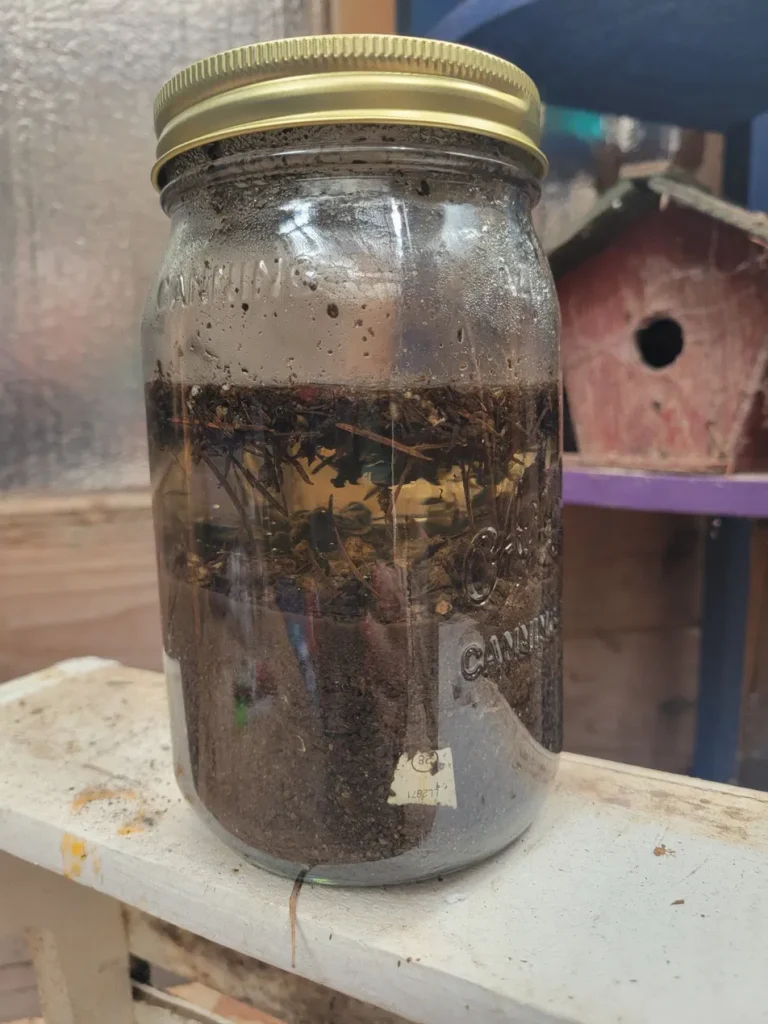
The jar test — with a twist. Scoop soil into a clear jar, add water and a squirt of dish soap, shake hard, and let it settle: sand drops in a minute, silt in a couple of hours, clay over a day or two, and you can read your soil’s texture from the layers. But here is the twist for bagged mix — it has almost no mineral texture to read. Shake up a jar of store-bought mix and most of it simply floats: organic fluff and wood, with maybe a thin whisper of sand at the bottom. That “failed” test is actually the most honest picture you’ll ever get. Set it next to a jar of your native ground — which, in our heavy clay, throws thick clean bands — and the two jars tell the whole story at a glance: dense mineral clay in one, floaty lifeless medium in the other, and instantly you understand why water and roots behave the way they do in a bed built from both.
The cotton test — the “is anything alive in here” test. This one is pure delight, and it’s real conservation-district science: bury a pair of 100% cotton underwear about three inches down, wait roughly sixty days, and dig it up. The more it’s been eaten, the more microbial life your soil has — healthy soil is full of hungry microbes that treat cotton as lunch. A soil scientist ran exactly our experiment and buried cotton in bagged potting soil: after the same stretch of time, it had decomposed barely at all, because the bagged mix simply didn’t contain the organisms to eat it. If you want proof your bed is alive (or isn’t yet), nothing beats it — and it’s a wonderful project to hand a child.
And the kit in the drawer. Most of us have bought one of those little capsule-or-strip kits at some point, brought it home, and then either never quite figured it out or never got around to using it. Here’s your permission to dig it back out — with a realistic sense of what it can and can’t tell you. These kits read pH and a rough N-P-K by color: the pH usually lands in the right neighborhood (extension trials have found it within about a point of a lab reading), and the nutrient results come in broad low/medium/high buckets — handy for a first peek, but too coarse to dose by. And notice the thing no capsule can show you: nothing about organic matter, and nothing about whether your soil is alive. The kit reads the chemistry of the medium, not whether it has become a soil. So use it as a five-minute starting glance — then let the jar, the cotton, and (when it matters) a lab fill in the parts that actually count.
And when the simple tests leave you guessing — call in the lab. The jar, the cotton, and the drawer kit will answer most questions for most beds. But when the readings are murky, or a bed keeps struggling after you’ve done everything right, that’s the moment for the authoritative backstop: a real lab test through your county. It measures the one number the home tests can’t — organic matter percentage, the best single proxy for how much life your soil can feed — alongside pH and the full nutrient picture, and it comes back with recommendations a capsule never could. Here in Thurston County, the Conservation District runs exactly this service for backyard gardeners: scoop a sample, drop it in the cooler in Tumwater, and a lab analysis with a plain-language write-up comes back. Wherever you live, your county conservation district or extension office is the same safety net. (Our one-page printable walks you through reading the report when it lands; grab it below.)
Bringing it back to life
Once you know it’s a lifeless medium, the repair is not to dose it with numbers — it’s to inoculate it with life. The simplest move is a generous helping of real, finished compost or worm castings worked into the top few inches: you are quite literally transplanting a living community into sterile ground, and from there it spreads. Everything else in this article is just feeding that community well.
Companion composting: feed each bed what nature already brings
If you already trench-compost — burying scraps right in the bed, the way we do — you have the perfect delivery system for something smarter: matching the input to what that particular bed needs. Worms and microbes move from the trench out into the root zone, and squash and cucumbers in particular grow famously well next to an active worm trench. Here’s the pantry, sorted by what each thing actually does:
Chicken poop — the nitrogen powerhouse. Higher in nitrogen (and potassium, phosphorus, and calcium) than most manures, composted chicken manure is a slow-release feast that also feeds soil microbes — ideal for nitrogen-hungry crops like squash, tomatoes, and corn. The firm rule: it must be aged or composted first. Fresh, it’s “hot” with ammonia and will burn plants, so for anything you’ll eat, compost it and let it cure — three to four months at minimum, six to be safe.
Maple leaves — but balanced. Fall leaves are gold for soil structure and water-holding, and maples rot faster than oaks. The catch: leaves are carbon (“browns”), not nitrogen — and a bed already full of wood is carbon-rich already. Pile bare leaves on and you can deepen the very nitrogen shortage you’re trying to fix. So layer leaves with the chicken manure or fresh grass clippings: the nitrogen feeds the microbes that break down the carbon. Browns and greens together — that’s the difference between a trench that builds soil and one that robs it.
And mineral by need. Tomatoes and squash prone to blossom-end rot are asking for calcium (your chicken manure already brings some; crushed eggshells and a little lime add more, though shells break down slowly). Fruiting beds wanting potassium can take a light dusting of wood ash — sparingly, since it raises pH. This is the heart of “companion composting”: you stop feeding the garden one generic thing and start feeding each bed what its crop is actually short on.
The payoff
Here is why none of this is bleak. A bed you bring to life this way doesn’t just survive — it compounds. The buried wood and the season’s compost become a sponge that holds water through August, the worms and microbes turn every fall’s leaves into next spring’s fertility, and by the second or third year the bed feeds heavy feeders without you reaching for a bag of anything. That is the same arc the feature traced in this month’s look at living soil, and the same conversion Gabe Brown went through on a 5,000-acre scale: stop feeding the plant, start feeding the life, and the life feeds the plant. A bag of garden mix isn’t a failed soil. It’s a soil that hasn’t been born yet — and you’re the one who gets to midwife it.
Reading Your Soil Test — The One-Page Field Guide
The whole report decoded on a single page: the pH sweet spot, the big three nutrients, organic matter, the repair table, and where to get tested locally. Print it, pin it to the potting shed.
Download the PDF →